
A significant bid by the United States in the United Nations for designating Pathankot attack mastermind Masood Azhar as a global terrorist has been stymied by China which has again opposed the ban against the Pakistan-based Jaish-e-Mohammed chief.

'The Modi government's greatest blunder is to exploit sensitive external relations in its domestic politics,' says Shekhar Gupta.

'There seem to be no reason why Assad should have launched such an attack when he was gaining acceptability,' says Brigadier S K Chatterji (retd).
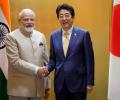
With the signing of the pact, the Quad grouping of India, Japan, Australia and the US is set to gain more heft now, notes Dr Rajaram Panda.

'The world may be desirous of peace, but not Kim Jong-un.' 'Should we then accept the old adage that to maintain peace, we should be prepared for war?' asks Rajaram Panda.

The Korean summit, laden with symbolism in everything from the choice of location to the mango mousse for dessert, could just be the first round in a continuing dialogue, says Dr Rajaram Panda.

This is a high-stakes strategic conflict between a power which wants to preserve the status quo in its favour and one which wants to usurp that throne. The rest is all theatre, says Harsh V Pant.

'Pyongyang's strategy seems to be a cry to be treated as equal with the US and Beijing and this aspiration is premised on equipping itself with weapons as devastating as theirs,' says Rajaram Panda.

The Japanese prime minister's visit to the memorial in Hawaii, the spot that was bombed 75 years ago, shows that it is possible for two powerful former enemies to transcend recriminatory impulses, observes Rajaram Panda.

'There shall be no change in India-Japan ties,' predicts Rajaram Panda.
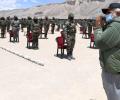
'...but from those who control the narrative.' Powerful nations have mastered this art of narrative building. Those nations who aspire to become global powers must do so, observes Shanthie Mariet D'Souza.

Girls in the Kashmir valley hurling defiance at the security forces will detract from the legitimacy of India's response and its standing in the world, says Ajai Shukla.

Modi will hold several bilateral meetings with the leaders of the SCO member countries including China's Xi Jinping.

'Progress demands regular senior-level attention from American leaders.' 'A leaders' summit is great, but we need sustained engagement to continue to forge new agreements and find new areas of cooperation.'

Prime Minister Modi told President Xi that he has made efforts to improve ties with Islamabad but these efforts have been "derailed".
US defence secy James Mattis said that Syria will pay a 'very, very stiff price' if it used chemical weapons again.
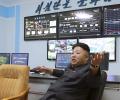
Will the unpredictable North Korean leader provoke conflict on the Korean peninsula?

'The coming two months could unfold unpredictable results or unpredictable consequences or both at the same time,' says Rajaram Panda.
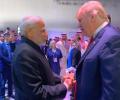
'India will come increasingly in the US crosshairs if it insists on maintaining its strategic autonomy, warns Ambassador M K Bhadrakumar.
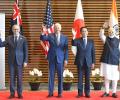
India has the ability in all respects to be a great power and address our security challenges in the best national interests, says Commodore Venugopal Menon (retd).

The US also blasted China and Russia for not joining hands with the international community in their efforts to combat the North Korean threat.

'The bigger challenge and dilemma for Pakistan would be if the US and Saudi Arabia go full throttle against Iran and enforce regime change in Tehran.' 'That would be bad news for Pakistan, especially with the current instability in Balochistan,' notes Brigadier Narender Kumar (retd).

'If some Europeans do not allow Muslims to assimilate into European national cultures, some Muslims also refuse to try and adopt and assimilate.'

'The world wants India to succeed. It also worries now that India over-promises and under-delivers,' says Shekhar Gupta.

'The fatal mistake for the USSR was the invasion of Afghanistan.' 'Quite possibly the fatal mistake for the Chinese empire is the assault on Ladakh,' observes Rajeev Srinivasan.

Possibly for the first time since Prime Minister Indira Gandhi called upon the nation to donate/sacrifice for the 'Bangladesh war' efforts, and also suffer blackout at nights with patience and pride, has the nation reacted so very positively to the government's diktat, says N Sathiya Moorthy.
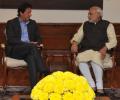
'A good opportunity has thus been provided for both countries to back away from the brink without loss of dignity.' 'There is every reason why they should strain every nerve, and grab every chance, shedding all thought of belligerence and showing who's the boss, to establish, maintain and preserve all it takes to lift themselves by their bootstraps,' says B S Raghavan, the distinguished civil servant.
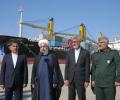
Iran's growing proximity to China may have also played a part.

'Why can't a person who has supervised military intelligence head RA&W?' 'Why can't one who has overseen national security planning become our NSA or chair the National Security Advisory Board?' asks Vice Admiral Premvir Das (retd).
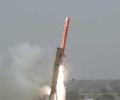
'Fearful of losing strategic advantage, the only option for Pakistan is to rattle its nuclear sabre!' 'Pakistan thereby hopes to play on the worldwide fear of an outbreak of nuclear war in South Asia,' says Colonel Anil A Athale (retd).

'When war is thrust on you as in 1962 and 1965 or is tempting as in 1971, ensure that all other fronts are kept quiet, leaving your army free to deal with one,' says Shekhar Gupta.
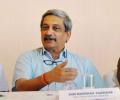
Instead of ramming through change, Mr Parrikar has tied his own hands by placing reform at the mercy of numerous committees, says Ajai Shukla.

'If the US-Pakistan relationship continues to suffer, Pakistan may feel it has less to lose and decide that it need not keep a leash on LeT in order to appease America.' 'A tougher US policy toward Pakistan could lead to an emboldened and strengthened LeT and JeM, resulting in more terrorist attacks in India.'
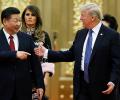
'We have here the world's largest economy and dominant superpower thrashing about as it wrestles with its own decline.' 'It has become everything that China was supposed to be: A threat to the world order, and as a country that is not playing by the rules on trade, on climate change, international commitments and nuclear deals,' says T N Ninan.
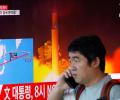
North Korea warns the US that it will soon 'suffer the greatest pain it ever experienced in its history'. Rajaram Panda looks at the latest twist in the North Korean crisis.
'The general perspective -- certainly on Capitol Hill and Congress -- the love for India, the positive feeling for India still focuses on India as a democracy.' 'The more that Indian democracy and its pluralistic features is called into question by Indians, the more that same debate will replay back here.'
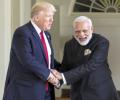
'The Modi government would chaff at the very idea of holding talks with Pakistan, facilitated by Washington and under close US monitoring, when the 2019 poll is sailing into view.' 'But in politics and diplomacy, there may be moments when drinking from the chalice of poison is necessary,' says Ambassador M K Bhadrakumar.

Iran's decision to keep India out and welcome China to the scene is a huge strategic setback for India, observes Dr Rajaram Panda.

By jettisoning the vision of multilateral world in favour of a Han Empire, China has posed a major long term challenge to India. India must stand firm against Chinese expansionism but also keep a door open for future detente by making a clear distinction between Chinese people and the current Chinese leadership, observe Lieutenant General Ashok Joshi (Retd) and Colonel Anil Athale (Retd).

Prime Minister Malcolm Turnbull's first State visit to India is an indication of the success of India's Act East Policy, says Dr Rahul Mishra.
